EXETER RADIO: ‘FIRST IN WINS’
The battle between the BBC and the Independent Broadcasting Authority for Exeter’s local radio station—also serving Torbay—will be decided on the basis of first come, first served.
Leader of the city council Mr Richard Van Oppen yesterday made it clear that this would be the approach, despite a resolution by a special sub-committee which gave stronger support to the BBC’s proposals.
The resolution, passed by the five-man sub-committee on local radio which will go to the next meeting of the policy committee, welcomed and strongly supported the BBC proposal to begin transmitting from Exeter in autumn 1979.
Mr Van Oppen said the BBC had the edge because it was essential there was a local radio station in Exeter as soon as possible. The BBC said they could start within a year, against the IBA’s two-to-three years.
He did not believe it would be possible for Exeter to have both BBC and IBA, but they would welcome both.
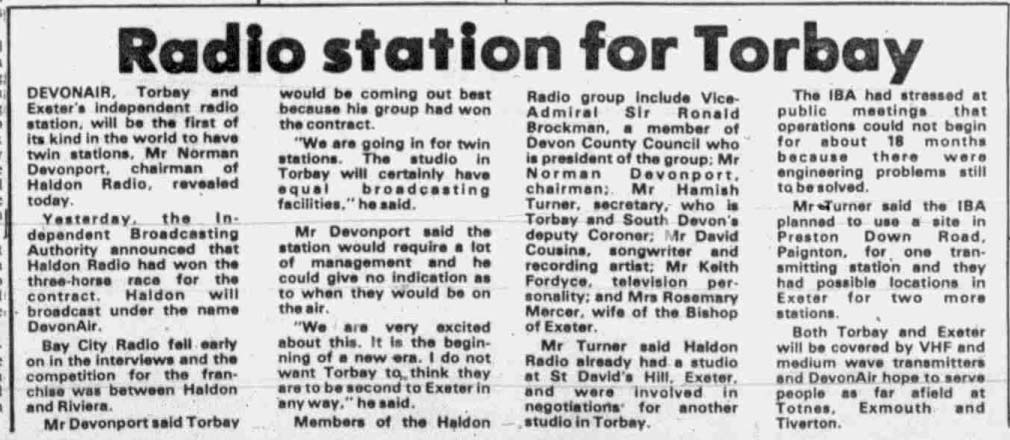
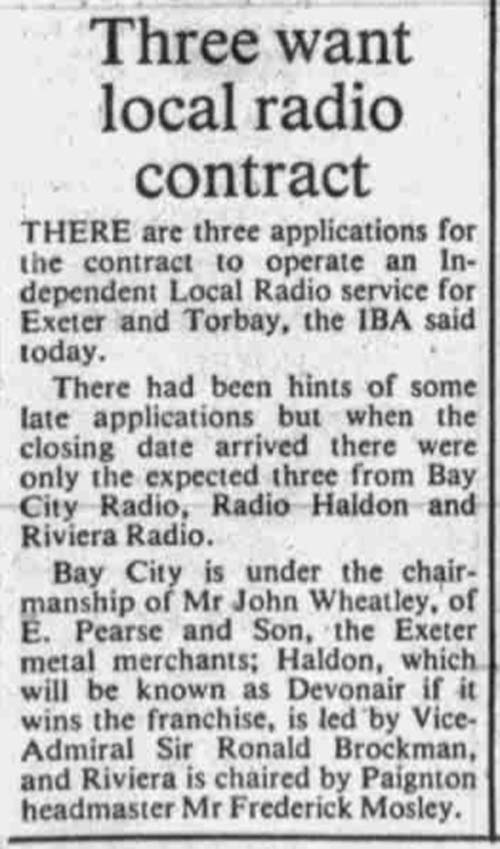
Another reason for favouring the BBC was that they would go out as Radio Exeter, while the IBA competitors, Bay City Radio and Riviera Radio, would not change their names to Exeter Radio.
The leader of the Labour group on the city council and a member of the sub-committee, Mr Patrick Spoerer, claimed the resolution passed was wishy-washy and should have positively come down on the side of the BBC.
A resolution should have been passed which would have encouraged the BBC to go ahead as quickly as possible and indicate to the Home Office the city’s feelings. Labour had moved an amendment to this effect.
Mr Spoerer said the Labour group did not object to commercial stations and would like to see both commercial and BBC in the city, but the BBC could provide local radio faster and with greater expertise.
If there was going to be only one station then the BBC could provide a wider programme content.
The sub-committee claimed it was important to have a station which was based in, radiated from, was identifiable with Exeter, and covered the area relevant to it, both now and in future.
The BBC also had an edge over the IBA in that they had a transmitter available for Exeter.
The Home Office, the BBC and the IBA will be told the sub-committee’s decision, but it is unlikely that there will be further developments until the autumn, when the Home Office Steering Committee on local radio meets.