I joined DevonAir in October 1980 after successfully auditioning for the station’s late-evening presenter role. Looking back, the audition was one of the most daunting experiences of my broadcasting career. Part of the process involved interviewing Programme Controller Jeff Winston about Russian dissidents—a subject on which he was extremely knowledgeable and one about which I knew very little. Despite my concerns, the audition evidently went well enough, and I was offered the weekday 10.00 pm to midnight programme.
From the outset, I was determined that the show would avoid some of the stereotypes often associated with late-night radio. There would be no endless sentimental orchestral music, no overly relaxed “smoking jacket” presentation style and no attempt to imitate other stations. Instead, the programme would be informative, engaging and companionable, offering listeners something a little different at the end of the day.
The programme became known as NightWatch, and it quickly developed a loyal following. One of its most distinctive features was a short item broadcast shortly before closedown each evening called DXers Corner. The feature had been devised by DevonAir’s Chief Engineer, Nick Johnson, and celebrated an interesting aspect of radio listening that was particularly popular at the time.
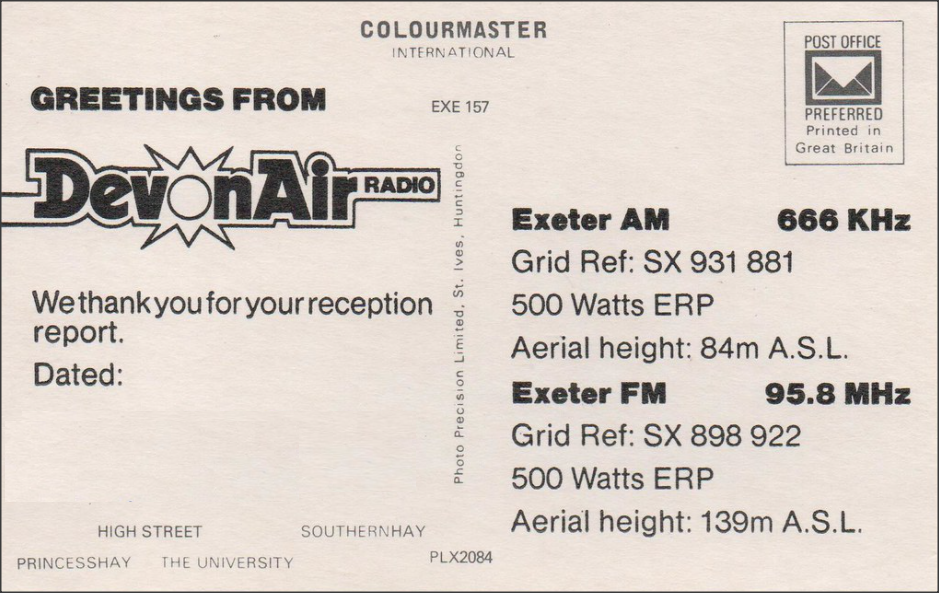
For readers unfamiliar with the term, DXing is the hobby of listening to radio stations from distant locations. The letters “DX” derive from telegraphic shorthand meaning “distance.” Radio enthusiasts, known as DXers, would spend hours searching the airwaves in the hope of receiving signals from stations far beyond their normal coverage areas. They would often send reception reports to stations, describing what they had heard, the signal quality and the time of reception. In return, stations would sometimes send a QSL card or letter confirming that the reception report was genuine.
Although DevonAir was a local radio station intended to serve Devon, atmospheric conditions occasionally allowed its signal to travel remarkable distances. Through DXers Corner, I would read out some of the more interesting reception reports we received. One of the most memorable came from Melbourne, Australia, where a DX enthusiast had managed to record DevonAir’s closedown sequence and submit it as evidence of reception. We also received reports from listeners across continental Europe and from many other unexpected locations. For a young station serving a relatively small part of the South West, it was fascinating to know that our signal was occasionally being heard thousands of miles away.
Presenting NightWatch remains one of the happiest periods of my time at DevonAir. The programme seemed to strike exactly the right balance for its audience. Listener research suggested that the show performed exceptionally well, with audience figures at 10.00 pm comparing favourably with some of the station’s daytime programmes. The format itself was straightforward, but that simplicity was one of its strengths. It provided good music, interesting conversation and a sense of companionship for those still awake at the end of the broadcasting day.
In 1983, however, the arrival of a new Programme Controller brought significant changes. He believed my abilities would be better utilised on daytime programming and moved me from evenings to daytime output. While I appreciated the confidence he had shown in me, the decision placed me in an area that was never a natural fit. My voice, style and broadcasting instincts were much better suited to late-evening radio than daytime presentation.
Over the next four years I found myself moved between different programmes and time slots. I was also given the title of Head of Presentation, although the role carried little practical authority and no additional remuneration. Despite my best efforts, I never returned to NightWatch, the programme that I had enjoyed most and which I felt best reflected my strengths as a broadcaster.
Around 1985, a new weekday magazine programme was created especially for me. It was called Waugh’s World, a title that neither I nor certain members of my family ever particularly liked. The programme itself faced difficulties from the outset. By that stage, station policy increasingly favoured shorter speech segments and a heavier emphasis on music. As a result, there was limited opportunity to develop the kind of personality-led magazine programme that the format required. In many respects, it was attempting to swim against the tide of contemporary commercial radio programming.
As the years passed, my relationship with the station’s management became increasingly strained. The enthusiasm and optimism that had characterised my early years at DevonAir gradually faded, and by 1987 I felt it was time to seek new opportunities elsewhere. After seven years with the station, I left DevonAir and moved on to the next stage of my broadcasting career.
Despite the frustrations of my later years there, my memories of the station remain overwhelmingly positive. DevonAir was a pioneering local radio service staffed by talented and dedicated people who helped establish independent local radio across Devon. Of all the programmes I presented during those years, NightWatch remains the one I remember most fondly—a programme that connected with its audience, embraced the magic of radio and, on occasion, reached listeners on the other side of the world.
Ian Waugh
DevonAir Radio, 1980–1987